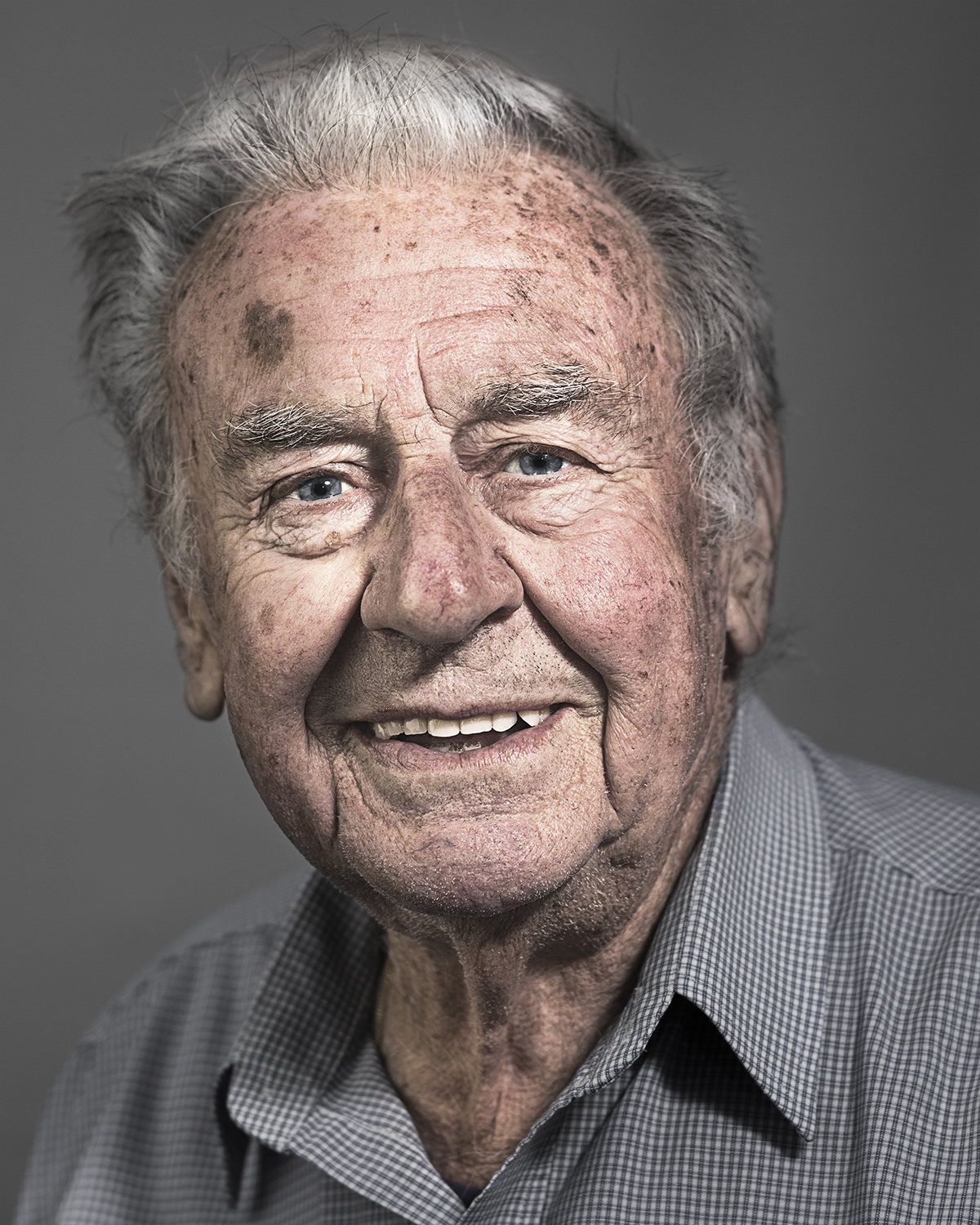
I witnessed an old man’s death this year. He was in hospital, being treated for an illness that he should have survived. He did not.
My uncle’s passing was an emotional rollercoaster of relief and grief; the relief clearly etched on his face, as his features relaxed after his final breath left his body; the grief mine, alone in a room with a man that would no longer demand a ‘smootch’ from me when I next saw him. There would be no next time.
During the eight weeks prior to his death, after finding him conscious but in very bad shape lying on the floor of his bedroom, I visited Bob in hospital almost daily. And, whilst attempting to convince, charm and/or cajole him into eating whichever meal it was that I was there to assist him with, I listened to his stories (many repeatedly) and observed him (also repeatedly) employ three simple and timeless activities. Together, these activities are his legacy:
Offer everyone you meet a smile
Bob would smile at everyone who approached him. Through this simple gesture, he would welcome them and invite them into his world. His was a wholehearted smile. Not some small turn at the corner of his lips, his smile was a wide, teeth baring, eye twinkling smile. It was a hard to resist smile, and very few did.
Of course, both in the hospital where he was diagnosed with an infection which required several weeks of antibiotics, and in the rehab centre where his treatment was delivered, there were some very serious or perhaps studious medical staff. As a teaching hospital, Bob had many doctors and nurses in various stages of their training attending to him. Yet, for those that may still have had some work to do on their bedside manner, Bob would ask them for a smile. He would grin at them and say “Where’s my smile?” or, when wishing to take yet another sample of blood or give him yet another injection, he would simply say, “Not before my smile.” And it worked. Every time. Of course, the next words where always, “Ah, there it is.” He would then let them get on with their business.
Having been at the end of this routine for the majority of my life, including having tried hard to resist the eventual smile (particularly during my teenage years), I would smile at the medical staff and give them the “don’t mind him, he’s just a silly old man” look. However, in return I was often given a look of true appreciation for a patient that was a pleasure to work with.
To me, once the staff had left the room, he would often say that he would never have wanted to be a nurse and commenting “it would be a hard job, that one”. Despite being the patient, and through his smile, he made an attempt to make the job easy for the staff that were attending to him and, in turn, they treated him with great care.
Show genuine interest in every person you meet
The number of individual medical staff that attended to Bob was extraordinary. As the first week of his hospitalisation was spent trying to determine the cause of his condition, an enormous amount of tests, scans, x-rays and ultrasounds meant that he encountered many new faces every day. Despite his condition, every single one of them was met with a smile and a question. If he could see a name tag, he would address his question to the person by name or, he would ask the person for their name. If the person had a name that he had not encountered before, he would simply ask them, “How do I pronounce your name?”
Now, Bob was deaf. Wholly and unequivocally deaf. His deafness was profound; full; complete. There was no need for the political correctness of “hearing impaired” when it came to Bob. At the age of 88, he had been unable to hear a sound since his early 30’s and, although he was quite adept at lip reading, communication was problematic enough. “Call a spade a spade”, he would say, “I’m deaf”.
It would have been easy for him to use his deafness to excuse a lack of interest in the people attending to him. However, despite not being able to hear the responses, Bob engaged with every single individual that crossed his path. Having travelled the world as a young man, he had a keen interest in far away places. If someone appeared to him to have originated from somewhere other than Australia (and, to Bob, that was almost anyone that wasn’t white, anglo-saxon), he would ask about their heritage – with genuine interest.
I remember one male nurse in particular. His heritage was Asian however, he was Australian. When Bob asked where he came from, a little offended by the assumption of the question (tact was another of the casualties of Bob’s deafness) the young man simply replied “Richmond”. Bob never heard the annoyance in his tone, so continued to plough through to find a connection. He struck gold when he commented on the man’s tattoos. In the few minutes that the nurse was attending to him, Bob told him about his father, a Royal Navy man who was apparently also covered with many tattoos (first time I’d every heard that story) and the nurse lingered after Bob’s drip was set to lift up a sleeve and show off some more of his ‘art’.
This genuine interest in others was met with a genuine interest in him. Whilst obviously employed to care for patients, the medical staff that attended to Bob showed a genuine interest in his care and progress. When I received the call to say that he had taken a turn for the worse and that he was being transferred to the emergency department of a larger hospital, I could hear the upset in the voice of the nurse I spoke with.
Always show gratitude (say ‘thank you’)
My Uncle Bob was raised a gentleman. Although his mother died when he was only 6 years old, his father remarried and he was largely raised by his step-mother, a woman he called Eva-mum. Eva-mum was reportedly a highly qualified theatre nurse or chef, depending upon which story you were being told, but definitely a strong woman with an even stronger moral compass. A tool-maker by trade, I’m sure Bob learned to hold his own with the boys however, Eva-mum had ensured that he possessed a strong sense of what was ‘proper’ or ‘right’ and that included a perhaps now old-fashioned view of manners.
Regardless of what they were doing to him, and what indignity he was being subjected to (think bed pans and incontinence pads as a place to start), Bob thanked each of the people who served him in some way; every single time. Despite whatever pain he may be in, and even in times of delirium, he would always say, “Thank you”.
Amongst his other ills, Bob had dementia. It had not been formally diagnosed (the existing tests for dementia are not designed for the deaf), however it was obvious to all. Despite his initial engagement with them, Bob had long forgotten the names of the medical team that served him and unless he could see their name tag, he referred to all of the women as ’Sis’. “Thanks, Sis”, he was heard to say repeatedly throughout the day. This thanks applied to the kitchen staff that delivered his meals (of which he mostly did not eat), the female doctors that treated him and, of course, the many, many nurses that attended to his personal care.
As a patient, Bob was one that could easily have been dismissed. As his health deteriorated, his ability to read lips diminished leaving us with the need to write our questions or information into a book for him to read. It would have been easy for the medical staff to not take the time to ensure that he understood them, given their time restraints and a patient/nurse ratio that was under pressure. Yet the majority of these relative strangers took the time, and put in the effort, to ensure that he understood what they needed or what they were there to do. In doing so, they truly cared for him.
Within 24 hours of being deemed medically fit, Bob was rushed by ambulance from the rehab centre back to the hospital where this journey first began. Along the way, he joked with the paramedics and engaged and entertained them with his stories and antics. When they handed him over to the emergency department staff, despite being gravely ill, Bob thanked them for looking after him. Before leaving the hospital to head back out on the beat, the paramedics returned to his cubicle to check on how he was doing. Although he was only 36 or so hours from his last breath, this old man was still living by this personal creed: offer a smile to everyone you meet; show genuine interest in all people and always, always say thank you.
Thank you, Uncle Bob. May you rest in peace.
 Contemporary portraits for everyone!